Research + education
Academic
Researching how game audio is perceived, built, and taught, with a focus on technical–artistic convergence and game-based learning.
Current research
Learning technical audio by making systems playable.
My doctoral work at Universidad Nacional de Quilmes explores game-based learning in video game audio education and the creation of tools that connect artistic listening with implementation practice. My research also examines sound perception, sonic hybridization, interactive music, and the ways audio communicates through mechanics, narrative, and virtual space.
This academic practice directly supports my work as an Audio Programmer and Technical Sound Designer. Building educational prototypes requires me to translate creative goals into clear runtime logic, design and test interactive audio behaviors, document complex systems, and create workflows that remain understandable to both technical and artistic teams. Research gives me a structured way to evaluate why an audio system works, while production experience keeps that research grounded in engines, middleware, code, and the realities of collaborative development.
2025 · Peer-reviewed article
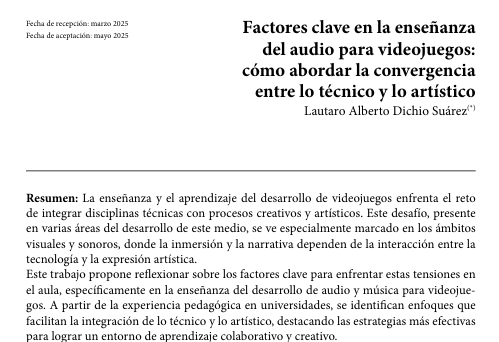
Key Factors in Teaching Video Game Audio
An examination of how video game audio education can bridge technical knowledge and artistic practice. Drawing from university teaching experience, the paper identifies project-based and collaborative strategies for developing creative, production-aware learning environments.
Read paper (PDF) →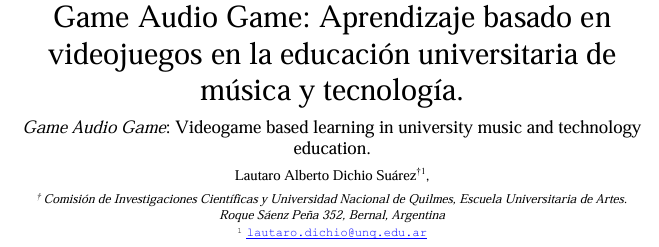
2023 · Conference paper
Game Audio Game: Video Game-Based Learning in University Education
Research on using a playable project to teach video game audio composition, implementation, and development. The paper connects intrinsic motivation, problem-solving, experimentation, and the practical application of technical audio concepts.
Read paper (PDF) →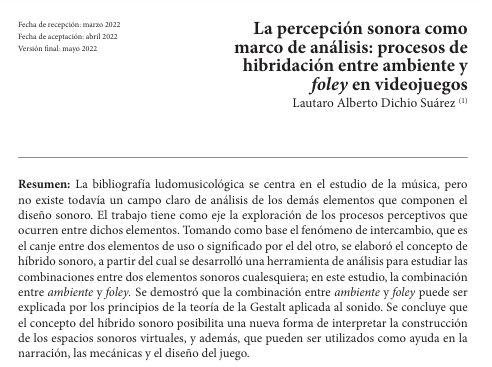
2022 · Peer-reviewed article
Sound Perception as an Analytical Framework
A framework for analyzing hybridization between ambience and foley in video games. The article uses perceptual and Gestalt principles to explain how sonic hybrids shape virtual spaces, support mechanics, and contribute to narrative design.
Read paper (PDF) →
2021 · Bachelor's thesis
Ambience-Foley Hybridization in 3D and Virtual Reality Games
A practice-based study of sonic hybridization supported by Perception, an artgame prototype developed in Unity with FMOD and ambisonic spatialization. The thesis connects theoretical analysis, interaction design, implementation, and technical prototyping.
Read thesis (PDF) →Game audio education
Sound perception
Sonic hybrids
Interactive music
Ludomusicology